Turiyo · গহনা বড়ি
Frequently Asked Questions About Gohona Bori
Frequently Asked Questions About Gohona Bori
What is Gohona Bori?
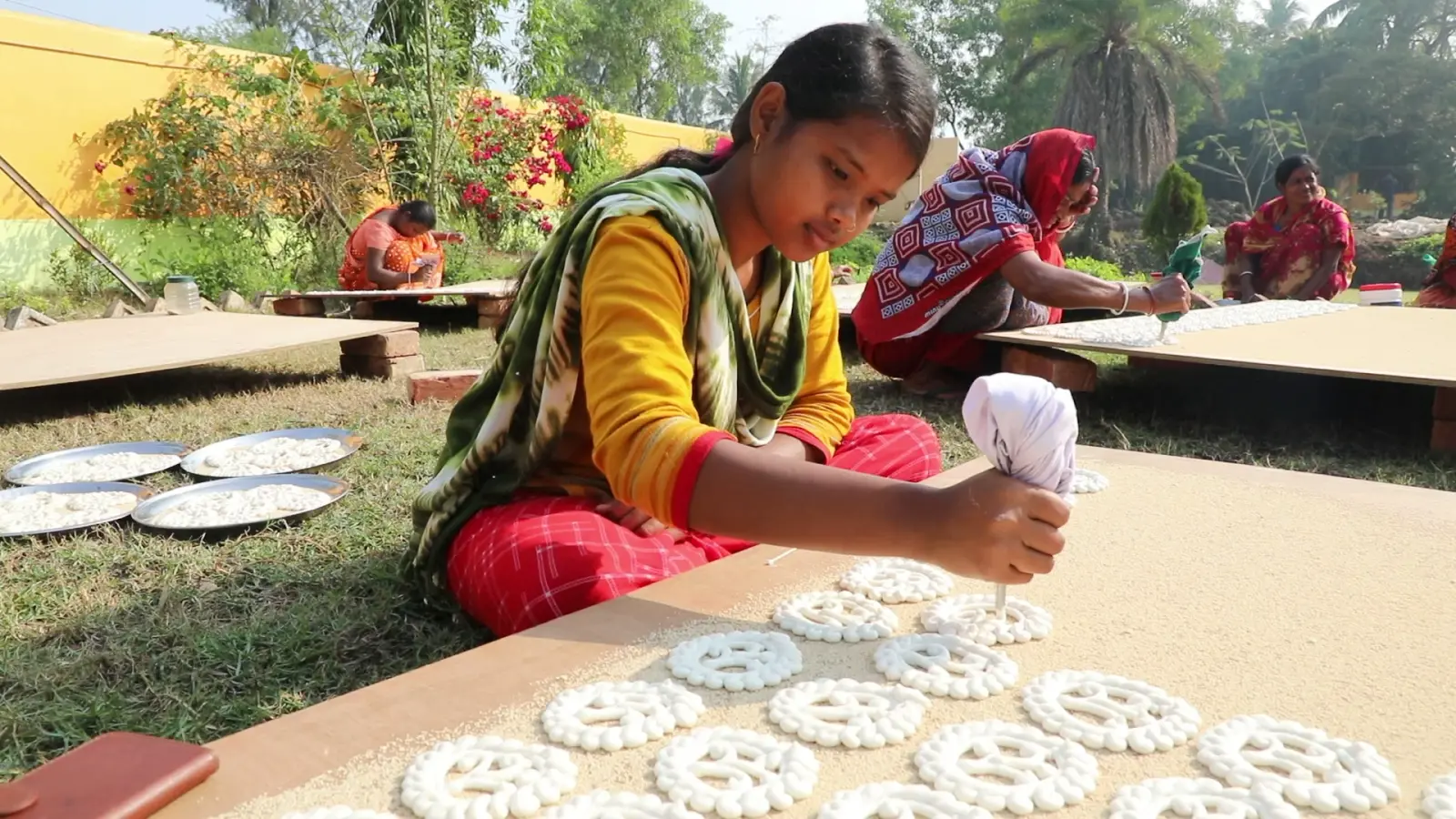
Gohona Bori (also called Naksha Bori) is a traditional Bengali lentil snack, handmade by soaking, grinding, and shaping seasoned lentil paste into intricate, jewellery-like patterns that resemble alpana art. It is then sun-dried in the winter months before being fried and eaten. The Gohona Bori Residency program is curated by Shimul Sarkar, supported by the local ladies at Turiyo Foundation, following this same age-old, entirely handmade process.
Why is it called “Gohona” Bori?
“Gohona” means jewellery or ornament in Bengali, and the name reflects the delicate, decorative patterns pressed into each bori — patterns that closely resemble traditional Bengali ornaments and alpana motifs.
Is there historical significance to this food art?
Yes. The eminent Bengali painter Nandalal Bose once described Gohona Bori as “jewels found in the frangible box of Mother Bengal.” The craft’s artistic value was also recognised by Rabindranath Tagore, who was struck enough by its intricate designs to have them preserved on the walls of Visva-Bharati as a tribute to the skill of local artisans.
Where is Gohona Bori traditionally made?
It is made in Purba (East) and parts of Paschim (West) Medinipur district in West Bengal. Purba and Paschim together formed the old, undivided Medinipur district. Even within this region, the craft is now known mainly to older women, and the number of people still practising it declines every year.
Why is Gohona Bori only made in winter?
The lentil batter needs cold weather to rise properly while it’s being whisked, and it needs clear, mellow winter sunshine to dry to the right crispness and bright white colour. If it clouds over even after a half-day of preparation, the batch cannot be saved — the soaked lentil paste cannot be stored or preserved for later use. This is why the working season runs roughly from November to February, when Purba Medinipur mornings are cool (around 10–15°C).
Is the process mechanised?
No, to date the process remains almost entirely handmade. Some people use machine blenders to grind the soaked lentils, but purists say the texture isn’t the same as when the lentils are ground the traditional way, using stone grinding tools known locally as shil-nora.
What is biuli’r dal, and is it the same as urad dal?
It belongs to the same lentil family as urad dal, but the biuli’r dal used for Gohona Bori is a local variant sourced from Purba Medinipur fields, prized for giving the right texture and finish.
Turiyo Foundation & Our Mission
What is Turiyo Foundation’s role in Gohona Bori?
Turiyo Foundation, based in Purba Medinipur, has been working since November 2021 to revive this dying food art. All Gohona Bori is made by ladies at Turiyo Foundation, following the traditional, entirely handmade method passed down through generations.
Has Turiyo Foundation’s focus changed over time?
Yes. Our early efforts were centred on commercialising the product and building a market for it. We have since moved away from that and adopted a slow, sustainable approach to preserving this dying art form. Our current and primary focus is on spreading the knowledge and art of Gohona Bori-making — sharing it with anyone genuinely interested in learning — rather than scaling it as a commercial product.
What is the explicit goal behind this shift?
Our main goal is to safeguard this heritage food art in its pristine, traditional form, free from the pressures of commercialisation. We want the craft — its techniques, patience, and authenticity — to survive on its own terms, for its own sake.
How did this initiative begin?
The founder of Turiyo Foundation, Sandip Maiti, grew up around this art form in his Kolkata home, watching his mother and grandmother make Gohona Bori effortlessly. He worked to salvage the intricate details of the craft and convinced family members to help pass this knowledge on to those from an urban background willing to learn it.
Who is involved in making Gohona Bori at Turiyo?
The initiative began with over 50 women from the local community. Outside experts were initially invited to train and mentor them, and today the effort is led by curators Shimul Sarkar and his mother, who work alongside a handful of local women to guide visitors through the process.
The Learning Residency Program
Can I actually learn to make Gohona Bori myself?
Yes. Turiyo Foundation now hosts a small number of individuals each winter who travel to Purba Medinipur and learn Gohona Bori-making hands-on using the shil-nora and other tools of the craft; the traditional way, directly from the ladies at Turiyo Foundation.
How is the program structured?
The experience runs over two nights. It begins with soaking the lentils (dal) in water overnight, followed by preparing the batter over two stages. Participants are guided through each step by the curators and local women assisting with the program, learning the nuances of grinding, shaping, and setting out the bori; then sun-drying it over a day and half before packing it and carrying it back home to enjoy with their loved ones.
What do participants take home?
Participants get to carry back all the Gohona Bori they personally make during their two-day stay.
Where do participants stay during the program?
Guests stay at the Maiti family’s estate in Purba Medinipur — a remote, 2+ acre Bengal village property. The setting and stay are considered part of the experience itself, alongside the craft-learning.
When is the program available?
Sign-ups are open for December 2026, with further dates available across winter 2027, since the craft can only be practised during the cool, dry winter months.
How many people can join at a time?
The program is intentionally kept small, hosting only a handful of individuals per session so that everyone gets close, hands-on guidance from the curators.
Ingredients, Quality & Ordering
What makes the ingredients special?
The best available ingredients are used, particularly poppy seeds, which form a base ingredient and are notably expensive (around INR 2,200 per kg).
What quality guarantee comes with the product?
All Gohona Bori made by ladies at Turiyo Foundation carry a guarantee of 100% authentic ingredients, including the use of food-grade poppy seeds.
Can people order Gohona Bori without joining the residency?
Yes. Turiyo Foundation also delivers to order and is open to serving a handful of customers each season, based on quantities booked in advance, before the winter production window begins.
Why can’t I order Gohona Bori year-round?
Because the entire process depends on winter weather — cold temperatures for the batter and clear sunshine for drying — production is only possible during the November-to-February window each year. Storage can be done only with utmost care but transporting them is a challenge because of the fragile nature. In the experience of Turiyo, gohona bori is best consumed fresh within a few months of making.
The Gohona Bori Experience
Two nights at Turiyo, Chauddhachuli, this December. See the dates and the shape of the days, or write or call us.